What Site Reliability Engineering (SRE) Taught Me About Systems & Building Intentional Ecosystems
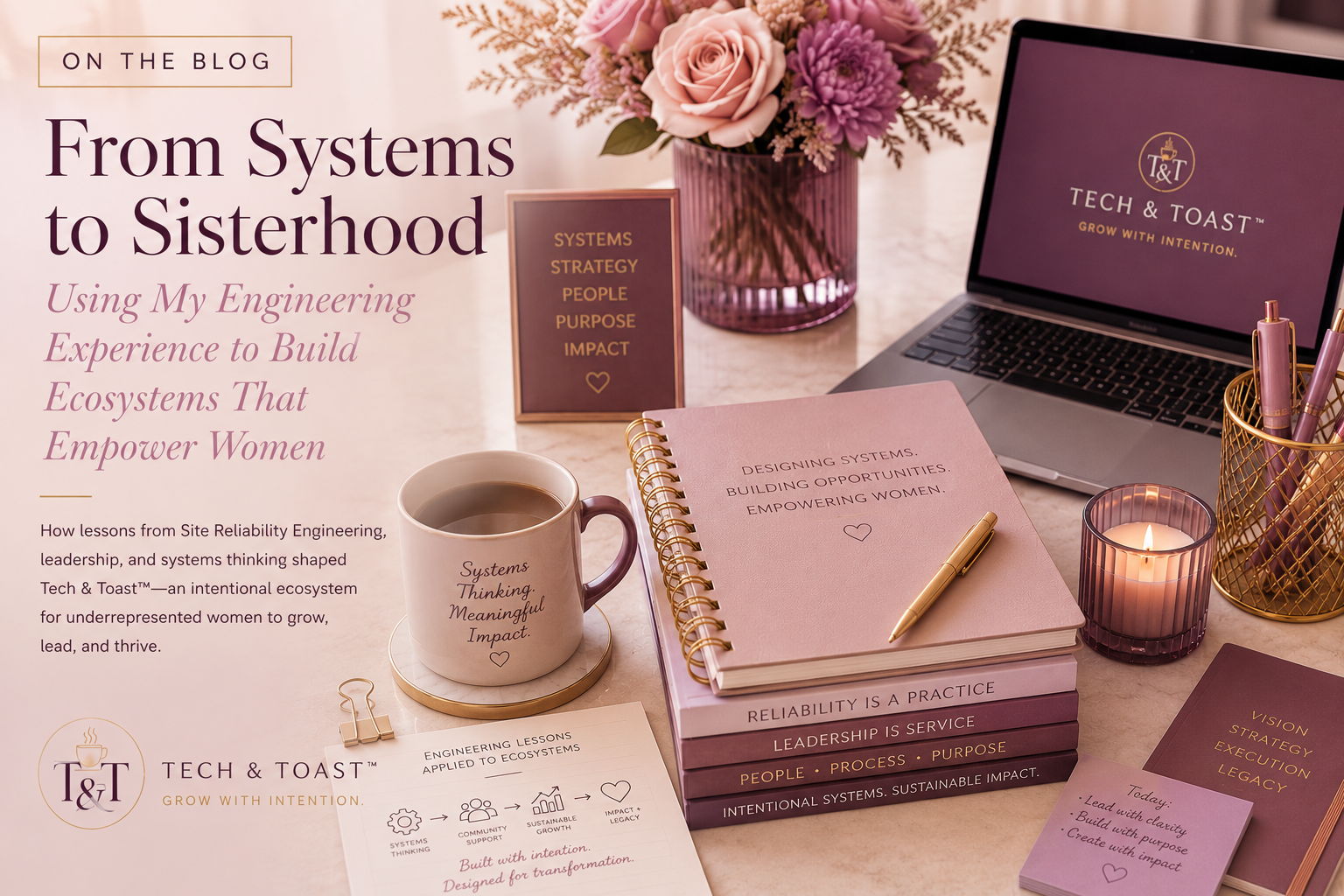
Opening Reflection
For a long time, I didn’t fully realize how much my experience in technology — especially as a Site Reliability Engineer — would shape the way I think about people, leadership, growth, and ecosystem design. At first glance, engineering and ecosystem building may seem unrelated.
One is highly technical, operational, process-driven, and centered around systems reliability.
The other appears softer:
community,
collaboration,
communication,
leadership,
creativity,
and professional growth.
But over time, I realized the connection was much deeper than I initially understood.
Some of the same principles that help technical systems remain stable, scalable, and sustainable under pressure are the same principles many people need in order to grow professionally without burning themselves out in the process.
And honestly, many of the ideas behind Tech & Toast™ were shaped during one of the most emotionally exhausting periods of my professional life.
Layoffs, Leadership & The Reality Many Professionals Are Facing
Like many people in technology, I experienced the uncertainty that came with layoffs and organizational instability post acquisition and restructuring.
One of the most eye-opening things about that experience was realizing how many highly capable professionals had no real exit strategy, no support systems, and no clear roadmap for navigating transition beyond immediately applying for another role.
At the same time, I found myself observing something else that became increasingly difficult to ignore:
people carrying leadership titles without meaningful leadership capability,
professionals feeling emotionally exhausted while still trying to perform at high levels,
and talented individuals struggling to position themselves despite being deeply skilled.
I remember applying for opportunities, facing rejection, and simultaneously watching people I had personally helped get hired move into larger organizations and spaces.
That experience forced me to think deeply about:
visibility,
positioning,
access,
and the difference between capability and opportunity.
And honestly, it also forced me to confront my own exhaustion, which included reassessing what I wanted in that moment, vs what I wanted when left to my own vices.
At that point, I realized the first thing I naturally leaned on was not motivation.
It was systems thinking.
I leaned on:
lessons from former managers,
operational frameworks,
scalable thinking,
documentation,
process structure,
and leadership observations from years of working in technical environments.
Without fully realizing it at the time, I had already been trained to think through instability systematically. I just hadn’t realized how to integrate all of it in a way that raised awareness the way I needed it to.
SRE Taught Me To Think More About Sustainable Systems
One of the things technical environments teach you, is that sustainable systems rarely happen accidentally.
Whether you are:
managing infrastructure,
responding to incidents,
improving reliability,
or scaling operations,
everything depends on:
clarity,
documentation,
communication,
repeatable processes,
operational readiness,
and understanding where breakdowns happen before they become larger problems.
In Site Reliability Engineering (SRE) specifically, incident response is centered around minimizing impact, improving stability, and resolving issues before they significantly affect the customer experience.
That requires:
calm communication under pressure,
process refinement,
pattern recognition,
scalable thinking,
and operational awareness.
The aformentioned traits I noticed I leaned on. Eventually I started realizing: many professionals — especially underrepresented women — were navigating their careers without access to those same types of intentional support systems.
People were trying to:
build businesses,
navigate leadership,
survive layoffs,
grow professionally,
increase visibility,
and pursue entrepreneurship
without:
frameworks,
strategic guidance,
psychologically safe environments,
operational support,
or sustainable developmental ecosystems.
Everything felt reactive. In SRE, proactivity is integrated into everything we build.
And many people were exhausted.
Why I Started Thinking About Ecosystems Instead Of Networking
One of the things that repeatedly frustrated me throughout my own professional experience was how often networking felt disconnected from actual implementation or long-term support.
People attend events.
Exchange contacts.
Post motivational content.
Offer surface-level advice.
They then tell you, “…it’s not what you know, but who you know”. Or, “It’s about likability”. Please remind me why we have an education system again? Certifications? Resumes? Application and ATS systems?
These same professionals still leave those environments without:
strategy,
accountability,
access,
operational understanding,
or meaningful relationship development.
I also noticed many women exploring entrepreneurship were being encouraged to simply:
start selling,
build visibility quickly,
market constantly,
and “figure it out.”
But very few conversations addressed:
sustainability,
scalability,
readiness,
process development,
strategic communication,
or how to build systems that actually support long-term growth when resources are limited.
And realistically, not everyone has immediate access to:
funding,
large teams,
expensive consultants,
or operational support.
That realization made me think differently.
I started asking myself:
“What would it look like to create an ecosystem where people could access these things, with intentional growth support, in a more scalable and emotionally intelligent way?”
That question became part of the foundation behind the Tech & Toast: Uncorked Ecosystem™.
The Creative Side Of Systems Thinking
One thing people who work closely with me often notice is that my creative expression is deeply intentional.
Almost everything I create has meaning attached to it. I do not feel fulfilled if it doesn’t.
The colors.
The structure.
The language.
The symbolism.
The ecosystem terminology.
The visual consistency.
Even the themes themselves are often reflections of larger ideas rather than literal aesthetics.
Tech & Toast™ or Tech & Toast: Uncorked™ is not truly about wine.
It is about:
intentional cultivation,
sustainable growth,
refinement,
process,
atmosphere,
connection,
and legacy.
Even the ecosystem structure itself reflects systems thinking.
The pathways.
The frameworks.
The guided progression.
The implementation layers.
The operational flow.
All of it reflects the way my mind naturally organizes information, experiences, and environments. Which is a good thing, since people love having those sorts of personal conversations with me.
And honestly, I think working in engineering roles strengthened my appreciation and understanding of my need for structure, while simultaneously enabling me to incorporate creativity and meaning.
Technical environments can become extremely fast-paced, emotionally draining, and operationally intense.
Creativity became one of the ways I processed that pressure while still maintaining a sense of identity beyond productivity.
What Many Underrepresented Women Are Actually Lacking
One of the hardest realizations I’ve had is that many underrepresented women are not lacking ambition, intelligence, or capability.
They are lacking:
access,
sustainable support,
strategic visibility,
psychologically safe growth environments,
intentional mentorship,
operational guidance,
and opportunities to explore creatively without constantly feeling pressured to survive professionally.
Everything becomes extremely transactional. You might as well forget it if you make a simple mistake that millions of others have made.
And in highly competitive environments, people often become afraid to share information because everyone is trying to protect their own opportunity, security, or paycheck. This eliminates true innovation and knowledge sharing.
The end result is collaboration becoming performative while psychological safety becomes more of a corporate phrase than an actual lived experience.
And over time, many women begin:
minimizing themselves,
suppressing creativity,
disconnecting from curiosity,
avoiding visibility,
and operating almost entirely in survival mode professionally.
That reality deeply impacted the way I wanted to build this ecosystem.
Because I didn’t want Tech & Toast™ to become another performative networking environment.
I wanted it to feel:
intentional,
emotionally intelligent,
operationally useful,
strategically grounded,
and creatively freeing.
Psychology, Leadership & Learning Patience Through Systems Thinking
Before technology, I studied psychology and behavioral science because I’ve always been fascinated by:
human behavior,
decision-making,
communication,
and the way people navigate scenarios emotionally and socially.
Ironically, working in SRE actually helped me to develop a healthier balance between emotional awareness and systems thinking. Bridging the gap for lack of better words.
Customer-centric engineering environments require you to assess situations carefully without becoming emotionally reactive, in ways that resonate with the customer experience vs. what we know of the system on the backend side of things.
You honestly learn:
patience,
operational analysis,
prioritization,
and how to focus on sustainable resolution rather than emotional urgency.
Depending on the cultures you’ve been in throughout your experience, heavily influences how much you have to “unlearn” when joining a healthy culture. And honestly, that experience shaped the way I approach this ecosystem too.
Naturally, I am not a patient person at all.
Especially when I don’t see traction.
But building thought leadership, frameworks, processes, and intentional developmental systems has indirectly forced me to slow down and think more sustainably.
Sometimes I joke that creating all of this is simply “busy work” , that distracts me from other things I want to scream about. It’s helped me to continue my learnings surrounding “becoming more patient”.
But truthfully, it also taught me something deeper:
… sustainable growth often requires infrastructure before acceleration.
That applies to systems.
And it applies to people too.
Certain work cultures will have us thinking otherwise. Sometimes it’s merely about finding your tribe.
Continuing The Conversation
Tech & Toast: Uncorked™ was never meant to be just another networking space. It was actually supposed to be a podcast lol A story for another day!
It was shaped by:
systems thinking,
operational experience,
leadership observations,
creativity,
psychology,
burnout,
reinvention,
and the realities many professionals and individuals are navigating quietly every day.
In many ways, this ecosystem is my attempt to apply everything I’ve learned about each area, and systems, to environments centered around people! Instead of the infrastructure alone.
Because people deserve more than constant survival professionally. And if I am being honest, infrastructure is a lot easier to manage than people!
However, individuals from all experiences still deserve:
intentional support,
strategic guidance,
sustainable development,
meaningful collaboration,
and environments where growth does not require losing themselves in the process.
And as I continue building my consulting work and the Tech & Toast: Uncorked Ecosystem™, I remain deeply interested in exploring what it looks like to create systems that are not only operationally thoughtful — but deeply humane too.
If these discussion points resonate with you, I invite you to come and explore the ecosystem. Come engage with our growing community, and participate in conversations centered around intentional growth, leadership transitions, visibility, sustainable development, and professional transformation.